Posts

Showing posts with the label geometry

Formula for the length of angle bisector in triangle.

Image
  [ABC] = a.c.sin(B)/2 [ABC] = [ABE] + [EBC] [ABE] = x.c.sin(B/2)/2 [EBC] = a.x.sin(B/2)/2 x = ac.sin(B)/sin(B/2).(a+c) x = ac/(a+c) * 2cos(B/2) BE = 2ac.cos(B/2)/(a+c)

Stewart's Theorem

Image
  Stewart's theorem Proof: Drop a perpendicular from A to BC at M. S.t. BM + MD = BD and CM - MD = CD AB^2 =  AM^2 + BM^2 => AM^2 = AB^2 - BM^2 = c^2 - (BD - MD)^2 = c^2 - (m - MD^2) Similarly: AM^2 = AC^2 - MC^2 = b^2 - (n - MD)^2 Now equate both to eliminate MD^2. Then multiply first equation by 'n', second by 'm' to eliminate the MD term. You will get the proof.

Finding reflection of a point across a line - co ordinate geometry

What is the reflection of (a,b) across y = mx + c? For e.g.  Reflection of (a,b) across y = x + 1. First draw a line passing through (a,b) perpendicular to y = x + 1. That will have slope = -1 So, y = -x + k => b = -a + k => k = a + b So  y = -x + a + b is the line. Now find intersection of these 2 lines. => a + b - x = x + 1 => 2x = a + b - 1 => x = (a + b - 1)/2, y = a + b + (1 - a - b)/2 = (a + b + 1)/2 Now,  this intersection point is the midpoint of (a,b) and its reflection (a',b'). So, (a ' + a)/2 = (a + b - 1)/2 => a' = b - 1 (b ' + b)/2 = (a + b + 1)/2 => b' = a + 1 So, reflection of (a,b) across y = x + 1 is (b-1,a+1).

Circumradius of a regular n-gon

Every regular n-gon has a circumcircle. And formula for the circumradius : R = a/2.sin(pi/n) So a regular hexagon is the only regular n-gon where circumradius  = side length.

RMO Geometry DPP 4

Image
  Solution: Part 1: (AEHZ) is cyclic quadrilateral since opposite angles HZA and HEA sum to 180. Its diameter is AH since it subtends 90 deg at circumference. N is the center since it's the midpoint of AH.   (NZMDE) are also concyclic since all these fall on 9-point circle of ABC. EZ is the common chord of these 2 circles and hence the radical axis. Angle NDM = 90 => MN is a diameter of this 9-point circle. Hence the center of this will lie on MN. So both the centers lie on the line MN. Line joining centers is perpendicular to the radical axis. H.P. Part 2: MN is perpendicular to EZ as both the centers lie on MN. The line containing both the centers will bisect the chord EZ in circle (AEHZ). In triangle AEZ, MN is the perpendicular bisector of EZ. So using Arc midpoint lemma MN and AI will meet on the circumcircle of AEZ and that point is K. Using the same lemma again MN and AI' will meet on the circumcircle again at L. K,N,L are colinear hence KL is a diameter. Hence KL =...

Angles made at Incenter,Orthocenter,Circumcenter in a triangle

In a triangle ABC, the vertices B,C make these angles: 1. At Incenter, angle BIC = 90 + A/2 2. At Orthocenter, angle BHC = B + C 3. At Circumcenter, angle BOC = 2A

A1H1 = A2H2 pending

In a circle where a chord BC subtends angles at A1,A2 on the circumference. Let H1,H2 be orthocenters of A1BC and A2BC. Then A1H1 = A2H2 Why? Since A1H1 = 2R.cosA1 A2H2 = 2R.cosA2 Circumradius is same and angles are also same.

Reflection of orthocenter wrt a side lies on circumcircle - pending

Image
 https://math.stackexchange.com/questions/589877/why-would-the-reflections-of-the-orthocentre-lie-on-the-circumcircle

Miquel's theorem

Image
 https://en.wikipedia.org/wiki/Miquel%27s_theorem Source: A beautiful journey through Olympiad

RMO Geometry DPP 2

Image
Radical axis questions. Facts used: 1. 3 Pairwise Radical axes of 3 circles are concurrent. 2. Common chord of 2 circles is their R.A.(radical axis) 3. Radical axis is all those points whose powers w.r.t. 2 circles are same. Power of a point P wr.t. a circle = PT^2 if PT is a tangent or PT1 * PT2 if a line drawn from P intersects circle at T1,T2. Question 1: Bulgarian Mathematical Olympiad 1996. Source . Question 2: Iranian Geometry Olympiad 2021. Source . Note that the same reasoning would work even if the ordering is AHG and not AGH.

Arc-midpoint (perpendicular-bisector ∧ angle-bisector) lemma – often nick-named “Fact 5"

Image
The statement Arc-midpoint (perpendicular-bisector ∧ angle-bisector) lemma – often nick-named “Fact 5”. In any triangle A B C ABC , the intersection E E of the internal (or external) bisector of ∠ C \angle C , and the perpendicular bisector of A B AB lies on the circumcircle ( A B C ) (ABC) . In fact, E E is the midpoint of the arc A B AB : with the internal bisector it is the midpoint of the arc A B AB not containing C C ; with the external bisector it is the midpoint of the arc A B AB containing C C . Proof: 1. Mid-arc argument (the slick one) Draw the circumcircle ω = ( A B C ) \omega=(ABC) and let M M be the midpoint of the minor arc A B AB (the arc that does not contain C C ). Why M M is on the perpendicular bisector of A B AB . Equal arcs subtend equal chords, so M A = M B MA=MB . Hence M M lies on the perpendicular bisector of A B AB . Because perpendicular bisector of AB contains all the points equidistant from A,B. Why M M is on...

A unique circle passes through 3 non-colinear points

As long as the three points are not all on one straight line, there is exactly one circle that passes through them . Why it’s unique Perpendicular-bisector construction Draw the perpendicular bisector of the segment joining points A and B. Draw the perpendicular bisector of the segment joining points B and C. Because A, B, C are not collinear, those two bisectors intersect at a single point O. O is equidistant from A, B, and C (that’s how perpendicular bisectors work), so OA = OB = OC. Taking O as the center and OA (or OB or OC) as the radius gives a circle that goes through all three points. Uniqueness follows from basic geometry If some other circle also passed through A, B, and C, its center would have to be equidistant from those three points too, so it would lie at the same intersection of the two bisectors – exactly at O. Only one intersection means only one possible center, hence only one circle. Edge cases Collinear points : If A, B, C lie on the...

RMO practice sheet - Geometry

Image
  Note 1: Note the location of P,Q. P could have been towards AD but if you do that, angle APD would be -40. Similarly for Q. Another fact which could have made the solution simpler: Look at triangle APQ. There is a point C inside it. Angle PCQ = 120 = 90 + A/2 So C is the incenter. So PC,QC are also angle bisectors. Note that we minimized y + 16 which would also minimize sqrt(y) which is in the numerator. Isn't that wrong? No. Since we minimized y + 16 and got it as an expression containing sqrt(y) which got cancelled out and gave us 3/4 which is independent of y. Another solution sketch. Solution: From power of a point: ZY * ZC = ZG * ZA ZX * ZB = ZG * ZA ZB = ZC since AZ is the median. =>  ZY * ZB = ZG * ZA ZX * ZB = ZG * ZA =>  ZY * ZB = ZX * ZB => ZX = ZY => AZ is also the median in triangle AXY. G already divides AZ in 2:1. So it's also the centroid for AXY triangle. Question 16: Appeared in RMO 2016. Explanation: DP bisects ADB because:  Triangle: ...

Ptolemy's theorem

Image
If a quadrilateral is cyclic then the product of the lengths of its diagonals is equal to the sum of the products of the lengths of the pairs of opposite sides. So: AC * BD = AB * CD + AD * BC

Triangle ex-radius properties

Image
Let's say a triangle ABC has 3 ex-circles. One of them is touching side BC at D and the extended line segments of AB and AC at E,F. Then Important Ex Radius Result Number 1: BD = s - c, CD = s - b and AE = AF = s. Where AB = c, BC = a and AC = b. Proof: And s = semi perimeter = (a + b + c)/2 Why? By equal tangents property: AE = AF, BE = BD and CD = CF Let BE = x => BD = x and CD = a - x = CF AE = c + x AF = b + a - x AE = AF => c + x = b + a - x => x = (b + a - c)/2 = s - c => BD = x = s - c => CD = a - (s - c) = a + c - s = s - b AE = AF = c + x = s Next: Area of the triangle in terms of ex-radius: Important Ex Radius Result Number 2: Ra = [ABC]/(s-a) Rb = [ABC]/(s-b) Rc = [ABC]/(s-c) Proof: [ABC] = Area of the triangle ABC. [ABC] = [CABIa] - [CBIa] [CABIa] = [CAIa] + [ABIa] [CAIa] = (base*height)/2 = (AC * DIa)/2 = (AC * Ra)/2 [ABIa] = (base*height)/2 = (AB * FIa)/2 = (AB * Ra)/2 => [CABIa] = Ra * (AB + AC)/2 [CBIa] = (BC * Ra)/2 => [ABC] = Ra * (AB + AC - B...

Mock test 1 - Q16 - pending

 Q16 - In a quadrilateral ABCD, it is given that AB = AD = 13, BC = CD = 20, BD = 24. If r is the radius of the circle inscribable in the quadrilateral, then what is the integer closest to r ? Solution  - PRMO 2018 question Answer: 8

Mock test 1 - Q13 - pending

Image
Q13. Let ABCD be a trapezium in which AB||CD and AD perpendicular to AB. Suppose ABCD has an incircle which touches AB at Q and CD at P. Given that PC = 36 and QB = 49, Find PQ.  Solution: Let incircle touch BC at R CR = 36, BR = 49 Further let inradius = r So AQ = PD = r and AD = 2r Let perpendicular from C meet AB at S So BS = 13, BC = 85 (CS)^2 = 85^2 - 13^2 = 98*72 = 84^2 CS = 84 = PQ

Mock test 1 - Q10 - pending

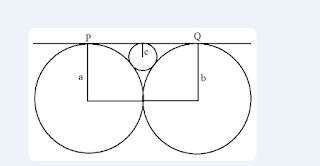
Image
Q10. Two circles with radii 4 and 9 respectively touch each other externally. Let c be the radius of a circle that touches these two circles as well as a common tangent to the two circles. Find 25c = ? Solution: Use  https://en.wikipedia.org/wiki/Descartes%27_theorem (k1 + k2 + k3 + k4)^2 = 2(k1^2 + k2^2 + k3^2 + k4^2) Here k4 = 0 for the straight line(0 curvature). k1 = 1/4, k2 = 1/9, k3 = 1/c It's a quadratic in k3. You will get k^2 - 26k/36 + 25/36^2 = 0. It has 2 solutions k = 1/36,25/36 => c = 36,36/25  Radius can't be 36 as seen in the diagram. So 25c = 36.

Q4 - mock-test-1 - pending

Image
Q4 : Let AB be a chord of a circle with centre O. Let C be a point on the circle such that ∠ABC = 30° and O lies inside triangle ABC. Let D be a point on AB such that ∠DCO = ∠OCB = 20°. Find the measure of ∠CDO in degrees. Solution: ∠ABC = 30° ⇒ ∠AOC = 60° Since angle subtended at circumference by chord is half of that at the center. Hence, △AOC is an equilateral triangle. Since OA = OC so opposite angles are equal, AOC is already 60 so these 2 angles will also be 60. So OA = OC = AC__________[1] △OCB is isosceles because OC = OB => ∠OCB = 20° = ∠OBC So ∠ABO = 10 △OAB is isosceles because OA = OB So ∠ABO = ∠OAB = 10 ∠CAD = ∠CAO + ∠OAB = 70 ∠DCA = ∠OCA - ∠DCO = 60 - 20 = 40 In △CAD, ∠CAD = 70, ∠DCA = 40 => ∠ADC = 70  => △CAD is an isosceles triangle. => OC = CA = CD (Using [1]) ∴ In △OCD, (OC = CD) and ∠DCO = 20 ∠ODC = 80° [Because OCD is isosceles]

Q3 - mock-test-1

Q3 -  In a triangle ABC, let E be the midpoint of AC and F be the midpoint of AB. The medians BE and CF intersect at G. Let Y and Z be the midpoints of BE and CF respectively. If the area of triangle ABC is 960, find the area of triangle GYZ. Note: This is an old PRMO question with a different numerical value. Solution . Answer here will be 20 due to numerical value being different.