Posts

Showing posts with the label mock-test-1

Mock test 1 - Q30

Same as PRMO 2012 question . It just asks m + n - 2000.

Mock test 1 - Q16 - pending

 Q16 - In a quadrilateral ABCD, it is given that AB = AD = 13, BC = CD = 20, BD = 24. If r is the radius of the circle inscribable in the quadrilateral, then what is the integer closest to r ? Solution  - PRMO 2018 question Answer: 8

Mock test 1 - Q13 - pending

Image
Q13. Let ABCD be a trapezium in which AB||CD and AD perpendicular to AB. Suppose ABCD has an incircle which touches AB at Q and CD at P. Given that PC = 36 and QB = 49, Find PQ.  Solution: Let incircle touch BC at R CR = 36, BR = 49 Further let inradius = r So AQ = PD = r and AD = 2r Let perpendicular from C meet AB at S So BS = 13, BC = 85 (CS)^2 = 85^2 - 13^2 = 98*72 = 84^2 CS = 84 = PQ

Mock test 1 - Q10 - pending

Image
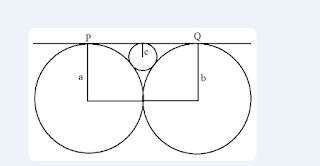
Q10. Two circles with radii 4 and 9 respectively touch each other externally. Let c be the radius of a circle that touches these two circles as well as a common tangent to the two circles. Find 25c = ? Solution: Use  https://en.wikipedia.org/wiki/Descartes%27_theorem (k1 + k2 + k3 + k4)^2 = 2(k1^2 + k2^2 + k3^2 + k4^2) Here k4 = 0 for the straight line(0 curvature). k1 = 1/4, k2 = 1/9, k3 = 1/c It's a quadratic in k3. You will get k^2 - 26k/36 + 25/36^2 = 0. It has 2 solutions k = 1/36,25/36 => c = 36,36/25  Radius can't be 36 as seen in the diagram. So 25c = 36.

Mock test 1 - Q7 - pending

Q7. An infinite geometric progression has sum of 8. The sum of series by squaring each term is 6 times the sum of original series. If common ratio of original series is r. Find 1/r. Answer: 1/7

Mock test 1 - Q6 - pending

Q6. Find (q+r) if (x-2)^2 is a factor of x^5 - 5qx + 4r = 0. Solution: If you do the long division eventually you will get this remainder: (-5q+80) x + (4r - 128). This should be 0. If a polynomial is 0, each of its factors has to be 0. 5q = 80 => q = 16. 4r = 128 => r = 32. Answer: 48.

Q4 - mock-test-1 - pending

Image
Q4 : Let AB be a chord of a circle with centre O. Let C be a point on the circle such that ∠ABC = 30° and O lies inside triangle ABC. Let D be a point on AB such that ∠DCO = ∠OCB = 20°. Find the measure of ∠CDO in degrees. Solution: ∠ABC = 30° ⇒ ∠AOC = 60° Since angle subtended at circumference by chord is half of that at the center. Hence, △AOC is an equilateral triangle. Since OA = OC so opposite angles are equal, AOC is already 60 so these 2 angles will also be 60. So OA = OC = AC__________[1] △OCB is isosceles because OC = OB => ∠OCB = 20° = ∠OBC So ∠ABO = 10 △OAB is isosceles because OA = OB So ∠ABO = ∠OAB = 10 ∠CAD = ∠CAO + ∠OAB = 70 ∠DCA = ∠OCA - ∠DCO = 60 - 20 = 40 In △CAD, ∠CAD = 70, ∠DCA = 40 => ∠ADC = 70  => △CAD is an isosceles triangle. => OC = CA = CD (Using [1]) ∴ In △OCD, (OC = CD) and ∠DCO = 20 ∠ODC = 80° [Because OCD is isosceles]

Q3 - mock-test-1

Q3 -  In a triangle ABC, let E be the midpoint of AC and F be the midpoint of AB. The medians BE and CF intersect at G. Let Y and Z be the midpoints of BE and CF respectively. If the area of triangle ABC is 960, find the area of triangle GYZ. Note: This is an old PRMO question with a different numerical value. Solution . Answer here will be 20 due to numerical value being different.

Q2 - mock test 1 pending

Image
Question 2: Let ABCD be a square of side length 5. A circle passing through A is tangent to segment CD at T and meets AB and AD again at X ≠ A X \ne A and Y ≠ A Y \ne A respectively given that X Y = 6 XY = 6 . Find A T 2 AT^2 . Solution: Let O be the center of the circle, and let Z be the foot from O to AD. Since XY is a diameter, OT = ZD = 3, so AZ = 2. Then O Z = 5 OZ = \sqrt{5} and A T = O Z 2 + 2 2 = 30 AT = \sqrt{OZ^2 + 2^2} = \sqrt{30} . Another solution: OT is perpendicular to DC. Extend OT so that it intersects AB at P. OAX is isosceles since OA = OX = radius = 3. AP = PX = sqrt(5). Triangle ATP is right angled at P. AT^2 = AP^2 + TP^2 = 30. TP = 5 = side length of the square.

Q17

Q17: "In △ABC, ∠A = 70°, D is on the side AC, and the angle bisector of ∠A intersects BD at H such that AH : HE = 3 : 1 and BH : HD = 5 : 3. Then ∠C in degrees is" Answer: 55 Solution: We use Angle Bisector Theorem and Mass points here. mA = 1 and mE = 3 => mH = 4. mB/mD = HD/BD = 3/5. Using mH = 4 we get mB = 3/2 and mD = 5/2. mC = mD - mA = 3/2. Using angle bisector theorem: AB/AC = EB/EC = mC/mB = (3/2)/(3/2) = 1 => AB = AC So ABC is iscosceles. Angle C = Angle B = (180-70)/2 = 55.

Q18

Image
Q18 In the trapezium A B C D ABCD , A D ∥ B C AD \parallel BC , ∠ B = 30 ∘ \angle B = 30^\circ & ∠ C = 60 ∘ \angle C = 60^\circ , E , M , F , N E, M, F, N are the midpoints of A B , B C , D C , D A AB, BC, DC, DA respectively. Given that B C = 7 BC = 7 , M N = 3 MN = 3 . Find E F EF . Solution: Set up the co-ordinates. B = (0,0) C = (7,0) M = (7/2,0) Let the height be h. So y co-ordinates of A,D = h. Let CD = c, since angle at C is 60 degree, we can use that to get x coord of D. Also h = c.sqrt(3)/2 D = (7-c/2,h) Similarly using the angle at B which is 30 degree, h = AB.sin(30) => AB = 2h = c.sqrt(3) x coord of A = AB.cos(30) = 3c/2 A = (3c/2,h) N = midpoint of AD = ((7+c)/2,h) MN^2 = 9 = h^2 + [(7+c)/2 - 7/2]^2 = h^2 + c^2/4 = c^2 (replace h) So MN  = c = CD = 3 Now, E = AB's midpoint = (3c/4,h/2) F = DC's midpoint = (7-c/4,h/2) EF = 7 - c/4 - 3c/4 = 7 - c = 4 = Answer. Another Solution:

Q19

Image
Q19 - In a trapezium ABCD, AB||CD and AB = 2CD. M, N are the midpoints of the diagonals AC and BD respectively. Let the perimeter of ABCD be L1, the perimeter of the quadrilateral CDMN be L2 and L1 = n.L2, find the value of n. Answer: 2 Solution: Put the co-ordinates like this: A (0,0), B (2CD,0) C (x+CD,y) D (x,y) M = (x+CD)/2, y/2 N = (x + 2CD)/2, y/2 Clearly MN is || to AB and CD. And MN  = CD/2 Perimeter of MNCD = L1 = MN + NC + CD + DM CD = CD MN = CD/2 NC = sqrt(x^4 + y^2/4)  DM = sqrt((x-CD)/2)^2 + y^4) L2 = AB + BC + CD + DA AB = 2CD CD = CD DA = sqrt(x^2 + y^2) BC = sqrt((x-CD)^2 + y^2) Clearly each segment in L2 is twice of that in L1. Hence n = 2. Another solution:

Q20

Image
 Q20 - In the diagram, circle O has a radius of 10, circle P is internally tangent to O and has a radius of 4. is tangent to circle P at T and, if drawn, line intersects circle O at points A and B. Compute the product TA•TB. Answer: 60 Solution: Extend QP and QT so that they intersect circle O at V and S, respectively. By the Power of a Point Theorem, in the big circle, Notice that QTS and ATB are chords in the big circle passing through the same point T, So AT.TB = QT.TS So if we find QT and TS, we are done. QV = 20(diameter of O). QP = QV - 4 = 16. Triangle QPT is right triangle so QT^2 = QP^2 - PT^2 = 256 - 16. QT = sqrt(240) = 4.sqrt(15). Now, QSV = 90 deg cause QV is the diameter subtending the angle at S. So QVS and QPT are similar. QP/QV = QT/QS = 4.sqrt(15)/QS = 16/20 QS = 5.sqrt(15) TS = QS- QT = sqrt(5) QT.TS = 4.5 = 20. 

Q21

Q21 - Find the number of integer solutions to ||x| - 2000| < 5. Answer: 18 Solution: |y| < 5 => -5 < y < 5 -5 < y => |x| - 2000 > -5 => |x| > 1995 => x < -1995 U x > 1995_____[1] y < 5 => |x| - 2000 < 5 => |x| < 2005 => -2005 < x < 2005________[2] We need to find intersection of [1] and [2]. LHS => -2005 < x< -1995 => x has 9 values in this region. RHS => 1995 < x < 2005 => x has 9 values in this region. Answer: 9 + 9 = 18.

Q22

Q22 - Let ABCD be a rectangle and let E and F be points on CD and BC respectively such that area (ADE) = 16, area (CEF) = 9 and area (ABF) = 25. What is the area of triangle AEF? Answer: 30 Solution: Let a,b be the sides of rectangle. Once you set up all the area equations for the triangle areas given, and remove all the variables except a,b, you will get a quadratic in (ab). Upon solving you will get ab = 80,20. ab = 20 not possible as the area of rectangle can't be less than the triangles inside it. So ab = 80. Area of the remaining triangle = 80 - (16+9+25) = 30.

Q23

Q23 - Let AB and CD be two parallel chords in a circle with radius 5 such that the centre O lies between these chords. Suppose AB = 6, CD = 8. Suppose further that the area of the part of the circle lying between the chords AB and CD is (m*pi + n)/k, where m, n, k are positive integers with gcd(m, n, k) = 1. What is the value of m + n + k ? Answer: 75. Solution: Let's calculate the area below both the chords and subtract from the total circle area to get the area between these 2 chords. Area below AB: If AB subtends angle x at the center then sin(x/2) = 3/5 => x = 2.arcsin(3/5) => area captured by the arc AB = (x/2Pi)*Pi*r^2 = (x/2)*r^2 = 25*arcsin(3/5) But this is the area captured by the arc AB. We just want the area below the chord AB. So we need to subtract the area captured by the triangle OAB. [OAB] = (1/2)*perpendicular from O on AB*AB = (1/2)*4*6 = 12. So finally area below the chord AB = 25*arcsin(3/5) - 12 Similarly area below the chord CD = 25*arcsin(4/5) - 12 So t...

Q24

q24 - The sides of a Triangle are three consecutive natural numbers and its largest angle is twice the smallest one. Determine perimeter of the triangle. Answer: 15 Solution: Let the sides be n , n + 1 , n + 2 n, n+1, n+2 . i.e., A C = n , A B = n + 1 , B C = n + 2 AC = n, AB = n+1, BC = n+2 Smallest angle is B B and largest one is A A . Here ∠ A = 2 ∠ B \angle A = 2 \angle B Also, ∠ A + ∠ B + ∠ C = 180 ∘ \angle A + \angle B + \angle C = 180^\circ ⇒ 3 ∠ B + ∠ C = 180 ∘ ⇒ ∠ C = 180 ∘ − 3 ∠ B \Rightarrow 3 \angle B + \angle C = 180^\circ \Rightarrow \angle C = 180^\circ - 3 \angle B We have, sine law as, sin ⁡ A n + 2 = sin ⁡ B n = sin ⁡ C n + 1 \frac{\sin A}{n+2} = \frac{\sin B}{n} = \frac{\sin C}{n+1} ⇒ sin ⁡ 2 B n + 2 = sin ⁡ B n = sin ⁡ ( 180 ∘ − 3 B ) n + 1 \Rightarrow \frac{\sin 2B}{n+2} = \frac{\sin B}{n} = \frac{\sin (180^\circ - 3B)}{n+1} ⇒ sin ⁡ 2 B n + 2 = sin ⁡ B n = sin ⁡ 3 B n + 1 \Rightarrow \frac{\sin 2B}{n+2} = \frac{\sin B}{n} = \frac{\sin 3B}{n+1} From (i)...

Q25

Q25 "Given that ( 1 + sin ⁡ t ) ( 1 + cos ⁡ t ) = 5 4 (1 + \sin t)(1 + \cos t) = \frac{5}{4} and ( 1 − sin ⁡ t ) ( 1 − cos ⁡ t ) = m n − k (1 - \sin t)(1 - \cos t) = \frac{m}{n} - \sqrt{k} , where k , m k, m and n n are positive integers with m m and n n relatively prime, find k + m + n + 3 k + m + n + 3 " Answer: 30 Solution sketch Let S = sin ⁡ t S=\sin t and C = cos ⁡ t C=\cos t . 1. Use the first condition ( 1 + S ) ( 1 + C ) = 5 4 (1+S)(1+C)=\tfrac54 ⟹    1 + S + C + S C = 5 4          ⇒       S + C + S C = 1 4 . (A) \Longrightarrow\;1+S+C+SC=\tfrac54\;\;\; \Rightarrow\;\; S+C+SC=\tfrac14. \tag{A} Define u = S + C , v = S C . u=S+C,\quad v=SC . Then (A) says u + v = 1 4 u+v=\tfrac14 . 2. Relate u u and v v with S 2 + C 2 = 1 S^2+C^2=1 S 2 + C 2 = ( S + C ) 2 − 2 S C = u 2 − 2 v = 1. (B) S^2+C^2=(S+C)^2-2SC=u^2-2v=1. \tag{B} 3. Solve the system From v = 1 4 − u v=\tfrac14-u (by A), substitute in (B): u 2 − 2  ⁣ ( 1 4 − u ) = 1       ⟹       u 2...

Q27

Image
Q27 - In △ A B C \triangle ABC , A B = 5 AB = 5 , B C = 7 BC = 7 , and C A = 8 CA = 8 . Let E E and F F be the feet of the altitudes from B B and C C , respectively, and let M M be the midpoint of B C BC . The area of triangle M E F MEF can be expressed as a b c \frac{a\sqrt{b}}{c} for positive integers a a , b b , and c c such that the greatest common divisor of a a and c c is 1 and b b is not divisible by the square of any prime. Compute a + b + c a + b + c . Solution: We first observe that quadrilateral EFBC is cyclic with circumcenter M(Thales theorem,BC diameter subtending 90 on circumference) since ∠ B E C = ∠ C F B = 90 ∘ \angle BEC = \angle CFB = 90^\circ . Thus, M B = M F = M E = M C = B C / 2 = 7 / 2 MB = MF = ME = MC = BC/2 = 7/2 as these segments are radii of the circumscribed circle of EFBC, so triangles △ M B F \triangle MBF , △ M E C \triangle MEC and △ M E F \triangle MEF are isosceles. From these observations, we reduce that ∠ B F M = ∠ B \angle BF...

Q26 - circle tangent power of a point theorem

Image